The Asynchronous Video Interview, Explained for People Who Hire
July 2026 · 7 min reading

The first time someone described an asynchronous video interview to me, I assumed it was a fancy name for a Zoom call nobody showed up to on time. It isn't. An asynchronous video interview is a screening method where a candidate records video answers to your questions on their own schedule, and you watch those answers whenever it suits you. Nobody is waiting on a shared calendar slot. Nobody is rescheduling for the third time because a sales call ran long.
That small shift — pulling the two halves of an interview apart in time — turns out to fix one of the most annoying parts of early-stage hiring. If you've ever tried to coordinate ten thirty-minute screening calls across three time zones in a single week, you already know the problem this solves. You just might not have known it had a name.
So this is the employer's-eye view, with the focus where it belongs for this format: on what happens when you stop requiring two people to be in the same place at the same moment.
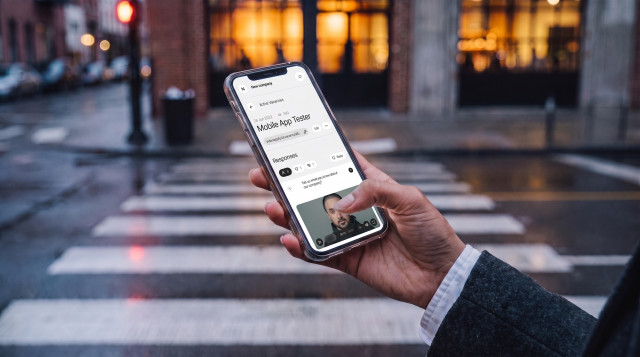

What Is an Asynchronous Video Interview?
An asynchronous interview is any interview where the questions and the answers happen at different times. In practice, for hiring, that almost always means video: you set a handful of questions, the candidate records themselves answering each one, and the recordings land in a dashboard for you to review later. You'll see the format called a few other things depending on who's writing — on-demand interview, one-way interview, pre-recorded interview — but the mechanic underneath is the same. The interaction is split. You ask now, they answer later, you review later still.
The word is borrowed straight from how engineers talk about messaging, and the borrowing is worth taking seriously, because it tells you how to think about the format. A synchronous exchange means both parties are present at once and blocked until the other responds — a phone call, a meeting, a live interview. An asynchronous one means the message is sent, sits in a queue, and gets picked up when the other side is free — email, a recorded Loom, a pull request comment. Teams that work across time zones already run most of their day this way, because synchronous communication doesn't survive a nine-hour gap between London and the West Coast. Hiring is one of the last parts of the process still stubbornly stuck in synchronous mode, and that's exactly why the screening stage hurts so much for a distributed team.
Why the Time-Shift Changes Hiring, Not Just Scheduling
It's tempting to file asynchronous interviews under "scheduling convenience" and move on. That undersells it. Decoupling the two halves of the conversation in time changes who you can reach and how fairly you can compare them, and those are bigger deals than a tidier calendar.
Start with reach. The moment you stop needing an overlapping free hour, geography stops filtering your pool. A strong candidate eight time zones away isn't quietly screened out because 2 p.m. your time is 1 a.m. theirs. The person currently heads-down in a demanding job, who can't take a discreet call at their desk, records at night instead. For a remote-first team hiring across countries, this isn't a nice-to-have; it's the difference between a real pool and whoever happens to be awake during your office hours.
Then there's the quieter effect on quality of judgment. In a live call, candidates are reacting in real time, and nerves can flatten an otherwise strong person — you're partly measuring their composure under surprise, which may have nothing to do with the job. Async takes the clock pressure off. Most tools let candidates re-record, so they've usually had a beat to gather a thought. We've watched people who came across as stiff and rehearsed on a live screen turn in warm, articulate recordings when nobody was staring back at them. Whether that's a feature depends on what you're hiring for — if composure under live fire is the actual job, you'll still want a real-time round — but for most screening, letting people answer when they're ready gets you closer to who they actually are.
And because the answers are recorded rather than lived-through-once, you can do something a live call never allows: hand them to someone else. A teammate opens the same link, watches the same three minutes, and weighs in — no second round of scheduling, no relying on your half-remembered notes from a call that's now four candidates ago. The time-shift doesn't just move the interview off your calendar; it turns a fleeting conversation into a durable, shareable artifact. We've seen that single property improve hiring decisions more than any clever question ever did.

Where Async Fits — and the Questions It Rewards
The format belongs at the screening stage, the early sort where your job is to go from a big messy pile down to a handful of people worth a real conversation. It is not built to replace the final interview, and trying to make it do that is how teams end up disappointed. (If you want the full map of where every video-interview format sits in the funnel, our guide to on-demand video interviews covers it end to end.)
Asynchronous Interview Questions That Work When Nobody's Watching
What's specific to the async format is how the time-shift shapes your questions. Because the candidate answers alone, on their own schedule, with time to think and the option to re-record, two kinds of question stop working. Anything with a single right answer that can be looked up will be looked up. Anything meant to test split-second composure measures nothing, because there's no "split second" — they had all evening. So you lean the other way: open questions about judgment, motivation, and how someone explains their own thinking, the things that get better when a person has a moment to compose them rather than worse. Save the live-pressure stuff for the live round. For a fuller bank to pull from, we keep a running list of questions worth asking and the ones to avoid.

How an Asynchronous Video Interview Works
The mechanics are quick, because the point of this page is the time-shift, not the button-clicking. You write three to seven open questions, you share a link, the candidate records on their own time with a short cap per question and the freedom to re-record, and the finished set lands with you to review whenever you get a clear hour. On a tool like VideoApply they don't create an account or download anything — they click the link, allow camera access, and go. That last detail matters more for async than for any live format, because the whole premise is removing friction from the candidate's side of the time gap; the candidate who has to register for yet another platform at 11 p.m. is the candidate who quietly drops off, and your reach advantage evaporates with them.
Some platforms add a layer on top. VideoApply, for instance, can generate a balanced set of screening questions from a short prompt and produce a recommended score out of ten for each candidate. Worth being precise about how that scoring works, because the wrong version of it is the thing to avoid: it reads the transcript of what the candidate said, not their face, not their voice, not their accent. It's advisory — a starting point for your own judgment, with the criteria shown to you, not a verdict handed down. The human still decides. Candidates consent to the recording and the transcript analysis before they apply, and the whole thing runs under GDPR. If a tool ever offers to rank people by reading their facial expressions, that's the cue to close the tab.

Getting the Async Part Right
Most of the ways this format goes wrong come from forgetting that there's a real person on the other end of a time gap, recording into a slightly intimidating camera box and then waiting. The asynchronous setup that frees up your week also leaves the candidate in suspense longer, so the etiquette is different from a live call. Tell them roughly how long it'll take and what you're looking for before they start. Then watch the recordings reasonably promptly — a video answer sitting unwatched for two weeks is a candidate quietly forming an opinion about your company, and the flexibility that won you their application curdles into the sense that they recorded into a void. Reply to everyone, including the people who didn't make it. The time-shift is supposed to give you your week back without taking the candidate's good faith in exchange.
If you want to try running one without stitching together three different tools, VideoApply lets you build the questions, share a no-login link, and review everything in one place — start a free async interview here.


