What Is an On-Demand Video Interview? A Practical Guide for Employers
July 2026 · 9 min reading
The first time I watched a founder try to fill one role, I counted seventeen back-and-forth emails before a single interview happened — for one candidate. Calendar invites that bounced, a reschedule, a no-show, then a second attempt at 7 a.m. her time because nobody checked the time zones. By the time they got on the call, the founder had half-decided to pass.
That's the part of hiring nobody warns you about on a small team. The interview itself is rarely the hard bit — it's the coordination, the dead time, the way a promising person slips through because you couldn't find a slot two weeks out. On-demand video interviews exist to cut most of that away.
We can say that with some conviction, because we didn't set out to build a hiring product at all. Our team hit this exact wall doing our own recruiting, went looking for a tool to fix it, couldn't find one we liked — so we built VideoApply for ourselves first, used it on our own openings, and only then opened it up. Most of what follows is less theory than a record of what did and didn't work when we were the ones drowning in applications.

What Is a Video Interview, and Where Does On-Demand Fit?
Worth getting the vocabulary straight first, because the terms get used loosely.
A video interview is any interview that happens over video instead of in a room. That covers two very different things. One is a live video interview — you and the candidate on a call at the same time, Zoom-style, just remote. The other is asynchronous, where nobody is online together: the candidate records answers on their own schedule, and you watch them on yours.
An on-demand video interview is that second kind. The employer sets the questions in advance, the candidate records video responses whenever it suits them, and the recordings wait for you to review. No shared calendar slot, no real-time pressure. You'll also hear it called an asynchronous video interview, a pre-recorded interview, or a one-way interview — mostly the same idea under different names, which we'll untangle later.
The reason it matters more for small teams is simple math. A live interview costs both people the same chunk of time, times however many candidates you've got — thirty applicants at thirty minutes each is fifteen hours gone before you've narrowed anything down. On-demand flips it: candidates each spend their fifteen minutes recording on their own time, and you spend a focused evening watching the ones worth watching. The cost of adding one more candidate drops close to zero.
Where On-Demand Interviews Fit in Your Hiring Process (the Screening Stage)
A common mistake is treating on-demand interviews as a replacement for the whole thing. They're not. They sit at the screening stage — where you've got a stack of applications and you're figuring out who's worth a real conversation.
The CV tells you what someone claims they've done; a live final interview tells you whether you want to work with them. The screening stage in between is where most hiring time leaks away, because you're trying to learn a little about a lot of people, and a little is all you need. You don't need a forty-minute deep dive to know a candidate can't string a sentence together about their own experience, or clearly applied to everything in the city without reading your post.
How badly this stage can balloon is easy to underestimate until it happens to you. One of our own HR managers recently posted a single QA opening and watched more than two thousand applications land in under four weeks. Opened by hand at three to five minutes each, that pile alone is over a hundred hours of work before a single real conversation — and that's before the phone screens. A hundred scheduling threads, a hundred calendars to negotiate, for a first pass that mostly ends in "no." Recorded answers are what made the number survivable: the strongest responses were surfaced and reviewed in a day or two, and the live calls were saved for the handful worth them.
There's a fairness angle too. When you phone-screen, the candidate you catch on a good day in a quiet room has an edge over the equally good one taking your call from a parking lot between shifts. Recorded answers level that: everyone gets the same questions, the same prep time, and as many retakes as they want. The comparison you make afterward is closer to a fair one.
How an On-Demand Interview Works, Step by Step
The mechanics are simpler than the name suggests — in practice it's about as complicated as sending a link.
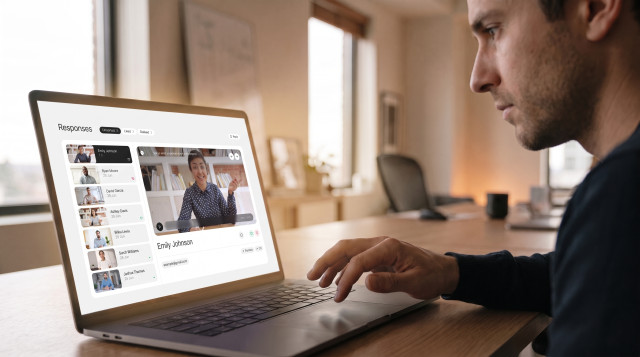
You write the job and a short set of questions — usually three to seven, because past that candidates flag and answers get thinner. You share a link. The candidate opens it, sees the role and the questions, and records a video answer to each, typically with a time limit per question. They can re-record until satisfied; the throwaway takes stay private. When they submit, the finished set lands in your dashboard.
On a platform like VideoApply, candidates don't even create an account — they click the link and record. That was one of the earliest things our own testing taught us: every extra signup step quietly cost us candidates, so we stripped the applicant side down to a single link and a one-time email code. The flow is mobile-first too, because a good chunk of candidates will be doing this from a phone, not a laptop at a desk.
What you get back isn't a transcript to skim. It's the person — how they think on the spot, whether they answer the question you actually asked, how they carry themselves with no interviewer nodding along. Without a live human reacting in real time, candidates have to self-start and stay coherent, and that tells you something a polished CV never will.
Writing Questions That Actually Pull Useful Answers
The format only works as well as the questions you put into it, and this is where most first-timers stumble.
The trap is asking things that reward preparation over substance. Since candidates get time to think and unlimited retakes, "tell me about a time you faced a challenge" gets you a rehearsed, sanded-down answer every applicant could give. Better to ask things tied to the role and to how the person thinks — what they'd prioritize in their first month, how they'd approach a specific problem your team has, why they left the last place. Open questions starting with what, how, and why pull fuller answers than anything you can close off with a yes.
One thing to avoid: hard-skills tests under pressure. Because the answers are unsupervised, a "solve this in three minutes" question proves nothing about how they'd perform when it counts. Save the technical gauntlet for a stage where you can watch them work. If you want a deeper breakdown, we've got a whole piece on video interview questions to ask and avoid, plus a shorter list of general questions that work well at the screening stage.
The Terminology, Briefly Untangled
Are an asynchronous interview, a pre-recorded interview, a one-way interview, and an on-demand interview all the same thing?
Roughly, yes — they all describe the candidate recording answers ahead of time for the employer to review later. The difference is emphasis: "asynchronous" stresses that the two sides aren't online together, "pre-recorded" that the answers exist before you watch them, "one-way" that there's no live exchange, "on-demand" that you review whenever you want. In practice, treat them as interchangeable.
On-Demand vs Live Video Interview: How Does a Video Interview Work in Practice?
People assume on-demand and live video interviews are rivals, one destined to replace the other. They're not — they're tools for different moments.
So how does a video interview actually work once you strip away the labels? In a live interview, you and the candidate are on a call together, reading each other in real time, able to follow up the moment something interesting comes up. That back-and-forth is irreplaceable for the final stage. The cost is coordination: two calendars, two time zones, one slot that works for both, and the rescheduling dance when something slips.
An on-demand interview drops the live part on purpose. The candidate answers on their own time, you watch on yours, nobody negotiates a calendar. You lose the follow-up; you gain scale and a level playing field. For screening a large pile down to a shortlist, that trade is almost always worth it — you're not trying to have a deep conversation with forty people, you're trying to find the eight worth one.
A simple way to decide: the more candidates, the more on-demand earns its place; the further along the process, the more you want live. Most teams run both — on-demand for screening, live for finalists — and they hand off cleanly. The recorded round filters, the live round decides. There's a quieter benefit too: because everyone answers the same questions in the same conditions, you spot the standout whose résumé reads flat but who's sharp the moment they start talking — the candidate a paper-only screen quietly loses.
Reviewing On-Demand Interview Answers Without Fooling Yourself
Here's where on-demand interviews can quietly go wrong, and it has nothing to do with the technology.
When you watch a stack of recorded answers in one sitting, your judgment drifts. The third candidate looks great partly because the second was a mess. You start scoring on confidence and camera presence rather than what the person said — and recorded video makes this worse than a live call, because you can rewatch and overanalyze a nervous pause you'd have forgiven in real time.
The fix is to decide what you're looking for before you press play. Write down the two or three things that matter for the role — clarity of thinking, relevant experience — and score against those, not a vague gut sense of "good." It feels mechanical the first time, then it becomes the thing that stops you hiring the most polished talker over the most capable person. We dug into this in a guide on how to analyze on-demand interviews and stay unbiased.
One more advantage of recorded answers over live calls: you can share them. A colleague can watch the same three minutes you did and tell you whether you're seeing something real or just reacting to a haircut. Live interviews don't give you that — once the call's over, all that's left is your notes and your memory, both unreliable.
Where AI Fits — and Where It Shouldn't
This is the part that makes people nervous, understandably, given how some hiring tools have behaved.
The version that deserves suspicion is the kind that watches a candidate's face, listens to their tone, and spits out a hireability score the company treats as gospel — a black box deciding someone's livelihood on whether they smiled enough. That's the wrong way to build this.
The approach that works is narrow and assistive. AI can take the busywork off your plate — drafting a first job description in your company's voice, suggesting a balanced set of screening questions, helping you sort a large pile so the strongest answers float up first.
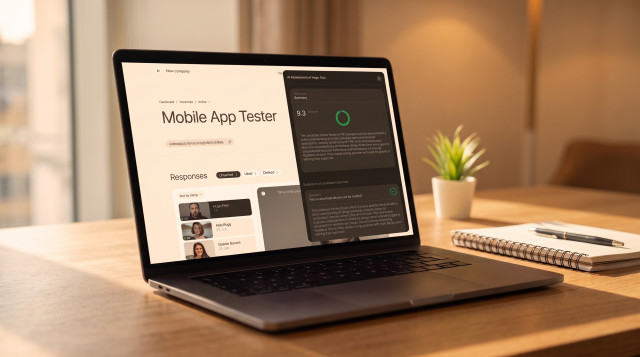
On VideoApply, AI stays in its lane. First, when setting up a role — a few words, and it drafts the vacancy plus a set of interview questions in a sensible order. Second, each question comes with its own evaluation criteria, sitting right next to the video when an answer comes in.
That's it. No transcript, no AI summary, no score forming behind the scenes. You watch, check the answer against the criteria, and decide. Data kept is just the basics — name, email, résumé, video.
The hiring call stays with you. AI just makes sure you know what to listen for going in.
Are On-Demand Interviews Right for Your Small Team?
On-demand interviews earn their keep most clearly when you're hiring at volume, when candidates are spread across time zones, or when you don't have hours in the week for first-round calls that go nowhere. They earn it least when you're hiring one senior person you'll want to build rapport with from the first contact — that's a relationship, and relationships want a live conversation.
For most small teams doing most of their hiring, though, the screening stage is exactly where time disappears, and an on demand interview is the format that buys it back. You stop scheduling. You start watching. The seventeen-email saga becomes a link and an evening.
If you want to see how it runs without committing to anything, VideoApply lets you post a role, send a link, and watch the answers come in — free to try while it's in beta.


