Full-cycle Recruiting in 7 Steps: Everything You Need to Know
May 2024 · 25 min reading
Behind every successful company’s workforce lies a set of recruitment strategies and workflows. One of the essential workflows is full-cycle recruiting, a complete approach to hiring that begins with the moment a job need is identified and doesn't end until a new hire is fully settled in their role, contributing to the company's goals. Mastering full-cycle recruiting will help you secure and retain the right talent, which, in today’s business environment, makes all the difference between a thriving company and one that is barely surviving.
What Is Full-cycle Recruiting?
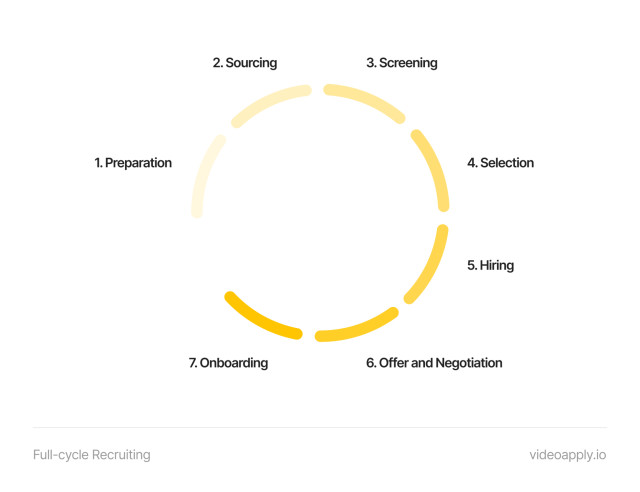
Full-cycle recruiting (recruitment), also known as end-to-end or 360-degree recruiting, is a recruitment strategy for talent acquisition where the recruiter or HR professional involved is responsible for every step of the recruitment process. It encompasses the initial identification of a vacancy, drawing up the job description, sourcing candidates, conducting interviews, negotiating job offers, and finally, overseeing the onboarding of new hires. It's a method that requires a versatile skill set, deep understanding of the company's culture, and a strong ability to align business objectives with talent management.
Adopting full-cycle recruiting helps organizations not only fill positions but also build the foundations for employee engagement, performance, and retention — key indicators of a company's health and growth potential.
Step 1: Preparing for Recruitment
Preparation step in full-cycle recruitment requires a series of actions: identifying hiring needs, establishing a recruiting team, and defining precise job descriptions and role requirements. Let’s examine each of these steps.
Identifying Hiring Needs
To correctly identify the hiring needs of your company, you should align the strategic goals of your organization with talent acquisition initiatives. Businesses must evaluate their current workforce capabilities against their short-term and long-term objectives to identify gaps that new hires could fill. It requires a keen understanding of market trends, internal employee development, and the competitive landscape. The objective is to create a robust blueprint that can withstand the dynamic nature of business demands and labor markets.
Establishing a Recruiting Team
Once the hiring needs are clearly defined, the next step in the full recruitment cycle is forming a dedicated recruiting team. Usually, the team is composed of HR professionals who also possess a deep understanding of the company’s culture, values, and the specific nuances of each role they recruit for. A multidisciplinary team often yields the best results, bringing together a mix of skills from sourcing and branding experts to interview specialists and onboarding coordinators.
However, it's important to note that a dedicated recruiting team is not always feasible, particularly for small businesses or startups without a formal HR department.
In such cases, full-cycle recruiting can still be effectively managed. Small businesses can approach this process by leveraging the skills of existing staff members who can take on recruiting responsibilities or by using external resources such as recruitment agencies or freelance HR consultants. Technology also plays a crucial role here, with various software and tools available to streamline the recruitment process, making it more manageable even without a specialized team. The key is to maintain a clear understanding of the hiring goals and to ensure that whoever is involved in the recruitment process, whether an internal team member or an external partner, is aligned with the company’s culture and objectives.
Job descriptions
Creating a job description in full-cycle recruiting is straightforward, but there are a few nuances you need to consider. The job description must capture the essence of the role in a succinct manner and serve both as a specification for the ideal candidate and a pitch to entice top talent.
Here are key points that must be included in any job description:
- Core Responsibilities: List primary job functions and daily tasks.
- Role Purpose: Clarify the role's contribution to company goals.
- Skills and Qualifications: Specify necessary technical skills, educational background, and professional qualifications.
- Competencies: Identify key behaviors and attributes for success in the role (e.g., teamwork, communication, problem-solving).
- Experience: Detail relevant work experience and its preferred scope (e.g., "5+ years in a managerial role").
- Advancement Potential: Outline opportunities for growth and career development within the organization.
- Cultural Fit: Highlight personality traits and values that align with the company culture.
- Expectations: Clearly define what success looks like in the position.
- Impact: Describe the potential impact of the role on the team and company at large.
- Flexibility and Adaptability: Note the ability to handle change or varied responsibilities, if applicable.
- Collaboration and Autonomy: Indicate the balance between teamwork and independent work expected in the role.
- Innovation and Creativity: If relevant, mention the desire for innovative thinking or creative problem-solving.
- Organizational Skills: Include if the role requires managing multiple tasks or projects simultaneously.
Each requirement should be carefully considered against industry standards and organizational needs to ensure they are neither excessively ambitious nor too modest. Keeping the descriptions balanced helps attract a pool of candidates who are well-suited and well-prepared to grow with the company, ensuring a long-term fit that benefits both the employee and the organization.
Step 2: Sourcing
The sourcing stage is a process of identifying and engaging with potential talent across various platforms and professional networks.

Strategies for Sourcing Talent
The search for qualified candidates begins with a clear understanding of the role's requirements and the ideal candidate profile. Recruiters use a variety of methods to source talent, each with its own pros and cons.
- Data-Driven Recruitment: Modern recruiters harness data analytics to understand where to find talent and how to appeal to them. They analyze previous hiring data, industry trends, and candidate behavior to identify sources of talent with the most potential and to predict hiring needs.
- Talent Mapping: A proactive approach that involves identifying and engaging with potential candidates before a position becomes available. This strategy anticipates future hiring needs and creates a pipeline of candidates who can be approached as soon as a role opens.
- Boolean Search: Recruiters use Boolean search logic to scour databases and online resumes for candidates that fit specific criteria. This search technique allows the combination of keywords with operators like AND, NOT, and OR to filter through vast amounts of data.
Utilizing Job Boards and Social Media
Job boards and social media serve as platforms for both active job seekers and passive candidates who are open to new opportunities.
- Optimizing Job Postings: Job listings are crafted with SEO principles in mind, using relevant keywords that resonate with the target audience. The aim is to increase visibility and attract a higher caliber of applicants.
- Social Recruiting: Platforms such as LinkedIn, Twitter, and even Instagram are utilized not just to post job openings but to showcase company culture, engage with potential candidates, and build a narrative that aligns with the aspirations of top talent.
- Social Media Analytics: Insights from social media analytics guide recruiters in fine-tuning their messaging and targeting, ensuring they reach the right audience at the right time with the right proposition.
Employee Referrals and Recruiting Events
Employee referrals and recruiting events remain two of the most personal and effective sourcing strategies.
- Leveraging Internal Networks: By tapping into the networks of existing employees, companies can source candidates who come pre-vetted and are more likely to fit the organizational culture.
- Structured Referral Programs: These programs are designed to motivate employees to refer quality candidates by offering incentives, recognition, or rewards.
- Hosting Career Events: Whether virtual or in-person, these events allow recruiters to meet candidates face-to-face, providing a deeper insight into the candidates' capabilities and fit.
- Industry Conferences: These gatherings are an opportunity to network with potential candidates who are already interested and engaged in the field.
Step 3: Screening
The screening stage of full-cycle recruiting is a process where resumes and applications are carefully reviewed to identify candidates who meet the minimum job requirements. This step determines which applicants will advance to the interview phase. The goal is to create a shortlist of the most promising candidates for further evaluation.

Developing a Screening Framework
A screening framework depends on the role requirements. Recruiters must identify the must-have skills and preferred qualifications that align with the role's responsibilities and the company's objectives. It usually includes:
- Minimum educational requirements
- Necessary certifications or technical skills
- Relevant work experience
- Soft skills that fit the company culture
Application Review Techniques
Reviewing applications is a task that demands both attention to detail and efficiency. Recruiters often employ techniques such as:
- Searching for specific skills and qualifications that are critical for the role.
- Looking for quantifiable achievements that align with the role
- Assessing the overall organization and clarity of the resume and cover letter
Initial Candidate Assessments
Preliminary screening is a way to further qualify candidates before investing in more time-intensive interview processes. This might involve:
- Screening calls to assess communication skills and immediate qualifications
- Short technical assessments to validate skills
- Personality or psychometric tests to gauge cultural fit
Automated Screening Tools
Technology plays a significant role in modern screening processes. Applicant Tracking Systems (ATS) and AI-driven tools are leveraged to:
- Automatically parse resumes for relevant experience and skills
- Rank candidates based on how well they match the job criteria
- Provide initial filtering before human review
Step 4: Selection
The selection phase in full-cycle recruiting is where recruiters consider each candidate's fit for the role and determine who will proceed to the final hiring decision.

Conducting Face-to-Face Interviews
Face-to-face interviews are constructed to elicit detailed information about a candidate’s skills, experiences, and workplace behaviors. Utilizing both behavioral and situational questions, these interviews are designed to create a detailed profile of each candidate.
Behavioral questions are based on the premise that past behavior is the best predictor of future behavior. Interviewers ask candidates to describe past work situations, which allows them to detail behaviors that indicate key competencies.
Situational questions, meanwhile, ask candidates to describe how they would handle theoretical future situations, providing insight into their problem-solving abilities and agility in the face of new challenges.
Selection Committees
The next step is to involve a selection committee in the process. A diverse selection committee can provide a range of perspectives, helping to reduce individual bias and ensure a fair assessment of each candidate. The committee should ideally be comprised of individuals from different departments and with different roles within the company, including those who will work directly with the new hire.
Candidate Evaluation
After the interview, each candidate is fairly evaluated. This typically involves a scoring system where committee members rate candidates on various competencies and qualifications required for the role. The use of a scoring system helps to quantify the evaluation process, making it easier to compare candidates objectively.
Post-interview debrief meetings are also an essential part of the candidate evaluation process. During these meetings, selection committee members come together to discuss their impressions and scores for each candidate. These discussions can provide additional insights that may not be evident from scores alone and help the committee reach a consensus on each candidate's suitability for the role.
Finalist Selection
The final stage of the selection phase is narrowing down the candidates to a shortlist of finalists. This involves a careful review of the scores and feedback from the interviews and debriefing meetings. It may also include further assessments or interviews to clarify any remaining questions about the candidates' abilities or fit with the company.
Narrowing down the top candidates for final interviews or assessments requires careful deliberation. The criteria for this selection might include:
- Interview performance, particularly in behavioral and situational responses.
- Consistency in scoring across various competencies.
- Consideration of team and organizational fit, based on the diverse perspectives of the selection committee.
Step 5: Hiring
Once a selection has been made, the process transitions into confirming the candidate's suitability through comprehensive checks, ensuring legal compliance, making the final hiring decision, and communicating with all candidates.

References and Background Checks
Reference checks involve reaching out to former employers, colleagues, or academic contacts to verify the candidate's claims and gather insights into their work habits and interpersonal skills. Background checks, on the other hand, delve into legal and financial records to ensure there are no issues that could impact the candidate's ability to fulfill their role. This might include looking into their criminal record, credit history, and any relevant industry-specific databases.
- Verification of Work History: Confirm past employment details, job titles, and responsibilities.
- Assessment of Work Performance: Gather qualitative data on the candidate's previous job performance, problem-solving skills, and teamwork capabilities.
- Background Verification: Check for any legal issues that might affect the candidate's suitability for the role. This includes criminal records, credit history, and right-to-work status.
Compliance Considerations
The hiring process is laden with legal implications, which necessitate strict adherence to labor laws and regulations. Key among these are the principles of equal employment opportunity and non-discriminatory practices. It's imperative to avoid any bias or discrimination based on race, gender, age, religion, disability, or sexual orientation.
Organizations must ensure that their hiring practices are transparent, documented, and consistently applied to all candidates to prevent any legal repercussions or damage to the company's reputation.
- EEO and Anti-Discrimination Laws: Ensuring hiring practices are in line with Equal Employment Opportunity laws and other anti-discrimination legislation.
- Documentation and Record-Keeping: Maintaining detailed records of the hiring process for each candidate to support transparency and accountability.
Hiring Decisions
Decision-making strategies often involve a collaborative approach, where input from all members of the selection committee is considered. The decision should be based on a combination of factors, including the candidate's performance in interviews, their reference and background checks, and their perceived fit within the company culture and team dynamics.
- Collaborative Decision Making: Engage key stakeholders in a discussion to reach a consensus on the preferred candidate.
- Balanced Assessment: Weigh interview performance, assessment results, references, and background checks to inform the final decision.
- Risk Mitigation: Consider potential risks and how they align with the candidate’s ability to meet job requirements.
Communication with Candidates
Communicating the hiring decision is the final step in the hiring phase. The way an organization communicates with both successful and unsuccessful candidates can significantly impact its employer brand. For successful candidates, the job offer should be clear, concise, and include all pertinent details regarding the role, compensation, and next steps. For those not selected, a respectful and professional rejection should be given. Providing feedback can be beneficial, but it must be handled delicately and constructively.
Step 6: Offer and Negotiation
Offer and Negotiation phase of the full-cycle recruitment is where an employer extends a job offer to a selected candidate and then engages in discussions to finalize the terms of employment. This stage involves careful consideration of factors like salary, benefits, job responsibilities, and other employment conditions. It's a delicate balance of ensuring the offer is attractive to the candidate while aligning with the organization's policies and budget constraints. Effective negotiation at this stage is key to securing the right talent and establishing a positive foundation for the employer-employee relationship.

Drawing Up the Job Offer
The job offer is more than just the salary. It's the total package that includes benefits, work-life balance, and career advancement opportunities. The salary should reflect both the role's value to the company and the candidate's expertise, experience, and potential. Benefits can range from health insurance and retirement plans to wellness programs and educational allowances. Other incentives might include performance bonuses, stock options, or sign-on bonuses. It’s important to tailor these to what you know about the candidate’s career priorities and life needs, as well as to ensure they’re competitive within your industry.
Negotiation Techniques
Negotiation is a natural and expected part of the offer process. Here are common practices you should consider using when driving negotiations:
- Preparation by knowing the market rates for the role and understanding the candidate's potential value to the company.
- Building rapport with the candidate to establish a foundation of trust.
- Listening actively to the candidate's concerns and questions.
- Being transparent about what the organization can offer and where there is flexibility.
- Striving for a win-win outcome where the candidate feels their needs are met and the organization gains a valuable team member.
Handling Counter-Offers
Counter-offers are a reality in the competitive job market. When a candidate receives a competing offer, the organization must quickly evaluate its position. Consider the following:
- The value of the candidate versus the cost of increasing the offer.
- The precedent it sets for future negotiations and the impact on internal equity.
- Whether non-monetary adjustments to the offer could be equally appealing, such as advancement opportunities or additional vacation time.
- It's crucial to maintain open communication with the candidate during this time to understand their priorities and to express the unique value proposition of joining your organization.
Finalizing the Offer
Once the offer details are settled, the next step is formalizing the agreement:
- Provide a written offer letter detailing the salary, benefits, and any special conditions or pre-requisites.
- Communicate expectations clearly regarding the timeline for acceptance and any necessary follow-up.
- Be prepared to address any last-minute questions or concerns the candidate might have.
- Once the offer is accepted, shift focus to a smooth onboarding process.
Step 7: Onboarding and Retention
The final stage of the full life cycle recruiting process doesn't conclude with a candidate's acceptance of the job offer; it extends into their integration into the company through onboarding and continues throughout their tenure with retention strategies.

Designing an Onboarding Program
A well-designed onboarding program is pivotal for new hires as it lays the groundwork for their success and satisfaction within the company. The onboarding process should familiarize new employees with the company culture, connect them with their colleagues, and provide them with the tools and information necessary to perform their jobs effectively.
A strategic onboarding program should:
- Begin before the first day with pre-onboarding communications.
- Include necessary administrative processes, such as paperwork and workstation setup.
- Incorporate an introduction to company culture, mission, and values.
- Offer role-specific training and clarify job expectations.
- Involve team introductions and relationship-building activities.
- Provide a clear 30-60-90 day plan with set goals and milestones.
Retention Strategies
Retaining talent is as crucial as hiring it. Long-term retention strategies are centered on creating an environment where employees feel valued, supported, and part of the company's future. Here are several pieces of advice that will help you boost retention in your organization.
- Career development paths that offer progression and growth opportunities.
- Regular performance reviews that track progress and address concerns.
- Competitive compensation packages aligned with industry standards.
- Mentorship and coaching programs to foster professional relationships.
- Employee recognition programs that celebrate achievements and milestones.
Incorporating continuous improvement within the hiring process and the subsequent onboarding experience is essential for maintaining the efficiency and effectiveness of recruitment strategies. This involves:
- Analyzing hiring metrics and performance data of new hires.
- Assessing the effectiveness of different recruitment channels.
- Soliciting feedback from recent hires on their experience.
- Adjusting recruitment strategies based on data-driven insights.


