5 Essential Recruitment KPIs for Small Businesses Without an HR Department
May 2024 · 13 min reading
Recruiting the right people is one of the most important factors that dictate the success of one’s business. With the competition in the labor market getting fiercer with each passing day, it becomes paramount for companies to leverage every advantage they have while pursuing top talent for their enterprises. Despite small businesses being at a natural disadvantage compared to large corporations with dedicated HR professionals, there are still a number of ways to get an upper hand in this highly competitive environment without employing the services of HR companies. Today we will go over recruitment KPIs that business owners can incorporate into their hiring routine to make their recruitment process as efficient as possible without the help of HR specialists.
Understanding Recruitment Metrics

KPI or Key Performance Indicator is a measurable set of parameters that gauge how effectively a person or company achieves a specific objective. Since the effectiveness of almost every type of work can be measured, KPIs become a point of reference when setting production goals within a business or estimating the number of closed deals within a certain time period. KPI calculation difficulty ranges from simple arithmetic manipulations to more complex formulas when several factors need to be included.
When it comes to recruitment KPIs, they are usually used to evaluate the overall performance of recruiters, keep track of the budget spent on hiring, and check the integration of new employees into the company. While acknowledged as essential tools for large corporations, recruitment KPIs are often overlooked by smaller businesses. Companies that rely on business owners and managers to conduct recruitment avoid using KPIs in order to keep things simple, but in reality they are doing themselves a disservice by losing valuable data that would potentially help them cut hiring costs and streamline the recruiting process.
Essential Recruitment KPIs to Monitor
Time-to-Fill:
What is it:
As you have probably already guessed, this recruitment KPI measures how long it takes to find a new employee for a specific vacancy or the time it takes to fill several positions over a specified time period.
How to calculate:
Depending on your needs, you can calculate Time-to-Fill for one position or average Time-to-FIll.
Time-to-Fill for one position:
To calculate Time-to-Fill for one position, you need to decide on a starting point and an endpoint of your calculations first. Some recruiters take the date when the job requisition was approved as a starting point, while others refer to the date when the position was advertised for the first time. Similarly, you can decide which date will act as an endpoint. For example, it can be the day when the negotiations were concluded and the candidate accepted your offer, or it can be their first day of onboarding.
After deciding on the dates, you can calculate the KPI. The formula would be:
The amount of calendar days between the starting point and the ending point.
Average Time-to-Fill:
Average Time-to-Fill formula looks like this:
Average Time-to-Fill=(Time-to-Fill position 1+Time-to-Fill position 2+…)/The amount of vacancies filled over the specified time period
Before calculating average Time-to-Fill You must decide on the time period you want to analyze.
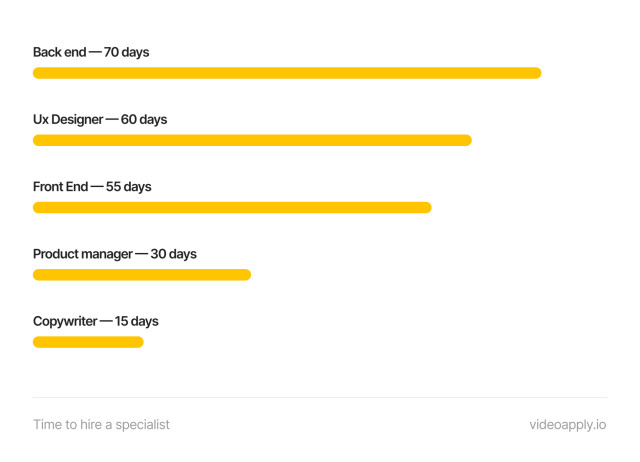
Example:
Let’s say your company employed 4 copywriters over a period of 3 months. It took your recruiters 10, 40, 60, 30 calendar days to hire them, respectively.
This is how your calculations would look:
Average Time-to-Fill=(10+40+60+30)/4
Your company’s average time to hire would be 35 days
What are the benefits of measuring it?
- Better Planning: By calculating Time-to-fill and analyzing the results, you come to a better understanding of how long it will take you to hire new employees for newly opened positions or to replace your current specialists.
- Setting priorities: As you continue keeping track of this KPI, you will be able to spot what you should focus your recruitment efforts on. You will get a solid grasp on which vacancies could use more advertising and which of them are easily filled with less effort.
- It is cost-effective: Time-to-fill will provide you with opportunities to save money. You will have the data needed to spot the open positions that organically attract prospective employees and cut expenses on the advertisement for them accordingly. Or you will be aware of vacancies that take a long time to fill, overextending the budget due to employees working overtime.
Cost per Hire:
What is it?
The Cost per Hire recruitment KPI refers to the average amount a company spends in order to acquire new talent. These costs may include sourcing expenses, recruitment advertising costs, accommodation and onboarding, etc.
How to calculate:
Before doing the math, you need to decide on the time period you want to calculate for. Once decided, identify how many employees your company has hired over the specified time period. You can also adjust the formula to calculate the expenses for specific roles.
The standard formula for calculating Cost per Hire is:
Cost per Hire = (Internal recruitment costs + External recruitment costs) / Total Number of Hires
Companies that don’t employ dedicated recruiters still have several internal recruitment expenses. These usually include compliance and administrative costs.
Compliance costs are usually associated with processing documents and the monitoring required to conduct recruitment in accordance with local law.
Administrative costs refer to expenses associated with internal support for the recruitment process, including but not limited to food, rent, transport, necessary equipment, and interview accommodation. If it is impossible to identify the precise amount spent on recruitment administration, it is advised to allocate an estimated percentage based on the recruitment headcount.
External costs still make up the majority of expenses for companies without HR departments. These include all the expenses incurred for external services and vendors during the recruitment process, such as position advertising costs, technological expanses, signing bonus, background checks, sourcing expenses, etc.
Example:
Let’s say you want to calculate Cost per Hire for a period of six months. During that time, you hired 6 specialists. You gathered the financial report, which show
| Internal recruitment costs: | External recruitment costs: |
|---|---|
|
Compliance costs 2000$ Additional equipment 500$ Accommodation: 1500$ Total 4000$ |
Background checks 2600$ Marketing costs 4500$ Technological expenses 2300$ Total 9400$ |
This is how your calculation would look:
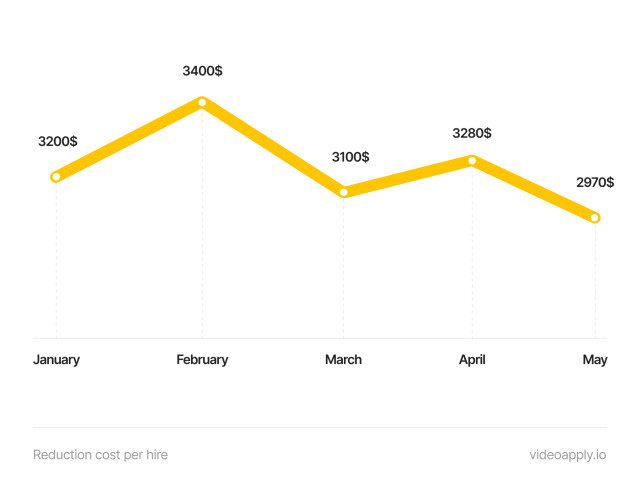
Cost per hire = (4000 + 9400)/6
Your average Cost per Hire would be $2233.34
What are the benefits of tracking it?
- Reevaluating the recruitment budget: Calculating Cost per Hire for a recent time period will assist in estimating the expenditures you will make on future recruitment. Cost per Hire will also help you get a rough outline of the current state of the labor market, especially if you’re not employing the services of professionals.
- Expenses management: While you may be under the impression that your company’s hiring costs are high, in reality, this may not be true. Of course, it’s obvious that recruiting a senior full stack developer is more expensive compared to hiring a junior administrator. Keeping track of CPH will assist you in understanding whether your recruitment spending is on par with the positions you are trying to fill.
Sourcing Channel Effectiveness
What is it?
Sourcing Channel Effectiveness (SCE) is a recruitment KPI used to identify the best sources of qualified candidates. The sources usually include employee referrals, previously interviewed candidates, job boards, and more.
How to calculate:
Firstly, decide on a time period you want to make calculations for. Then identify the source of qualified employees you hired and the overall number of candidates who applied via the same channel over the period of time in question. The standard formula to calculate Sourcing Channel Effectiveness is:
SCE(%)= Number of qualified employees / Number of applicants * 100
SCE formula is highly flexible and can be easily adjusted to your needs.
Example:
Let’s say you want to assess the average sourcing effectiveness of different job boards.
Imagine that you hired 50 employees out of 120 candidates who applied through job boards: 27 out of 41 through LInkedIn.com, 13 out of 22 through Indeed.com and 10 out of 57 through Glassdoor.com The calculations behind the average SCE of all job boards would be:
aSCE(%)=50/120*100
Average SCE of job boards would be 41.66%
If you want to calculate SCE of each job board separately, the calculations would be:
LinkedIn SCE(%)= 27/41*100
Indeed SCE(%)=13/22*100
Glassdoor SCE(%)=10/57*100
The SCE for each job board would be 65.85%, 59,09% and 17,54%, respectively.
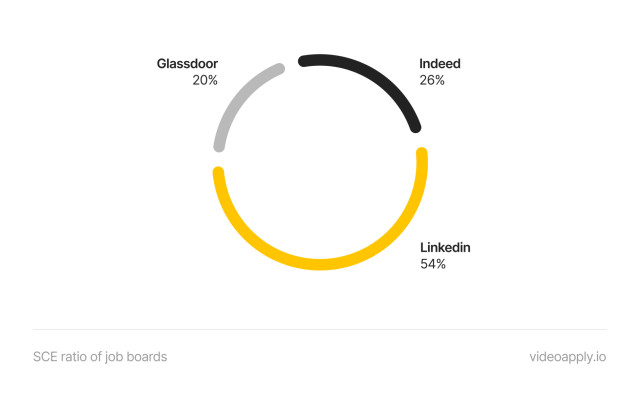
If you want to see the SCE ratio for the job boards, you need to divide each number of qualified employees sourced through job boards by the total number of hired employees:
LinkedIn SCE(%)= 27/50*100
Indeed SCE(%)=13/50*100
Glassdoor SCE(%)=10/50*100
These calculations will result in the following ratio:
What are the benefits of measuring it?
Identifying trends:
By tracking the sourcing effectiveness of different channels (SCE), you can recognize certain patterns that will assist you in adjusting the company’s recruitment strategy. For example, you will be able to discern which sourcing channels are best used to hire experienced employees for specific roles.
Cutting the expenses:
By calculating SCE you will be able to identify which sourcing channels work best for your company. This will also enable you to cut expenses on the sourcing channels that do not produce a satisfying number of qualified employees and focus on the channels delivering the best results.
Application Completion Rate
What is it?
Application Completion Rate (ACR) is a recruitment KPI that measures how many candidates who began the application process finished it and how many dropped it midway. ACR is usually used to check the effectiveness of application forms posted on company websites and job boards.
How to calculate
As with other metrics, you need to specify the time period for which you want to calculate. Once decided, you need to check how many candidates started the application form and how many actually submitted applications.
The standard Application Completion Rate formula is:
ACR(%)= Number of submitted applications/ Number of started applications * 100
You can calculate ACR separately for each website or job board or for all of them at once, depending on your needs.
Example:
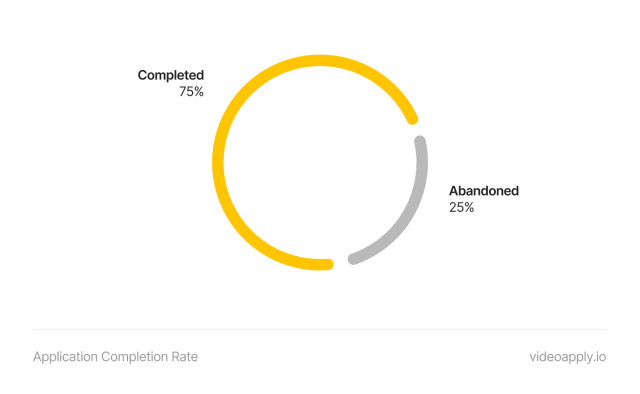
Let’s say you have a company website where the application process is conducted. You can see that over the period of 10 months, there were 120 candidates who started to fill out the application forms, but you received only 90 applications.
The calculations will look like this:
ACR(%)= 90/120*100
In this case, your ACR would be 75%
What are the benefits of measuring it?
Enhancing the candidate experience:
There are few reasons for a low Application Completion Rate. This is usually due to the application form being overly cumbersome or confusing. Additionally, candidates may find some of the requirements infringing upon their privacy, so you should consider editing them or providing an explanation for the necessity of that information.
Optimizing for the role requirements:
Low Application Completion Rate is not always a negative thing. It naturally occurs if the requirements for the open role are high. However, the scarcity of qualified candidates makes it even more important for your application form to be easy to complete without any technical issues. Tracking ACR will help you deduce whether your application process is performing within acceptable margins.
New Hire Turnover
What is it?
New Hire Turnover (NHT), also known as First-year Attrition, is a recruitment KPI that gauges how many candidates leave the company during the first year after their initial employment. This is a key metric that basically indicates hiring success.
How to calculate:
NHT is usually calculated annually. There are several ways to go about it, depending on your needs.
New Hire Turnover as a percentage of total annual turnover
This is not the most common way to calculate NHT, but it can offer an interesting perspective if your company faces an unusually high number of turnovers. In this case, NHT will be a subset of the total number of turnovers. The formula is:
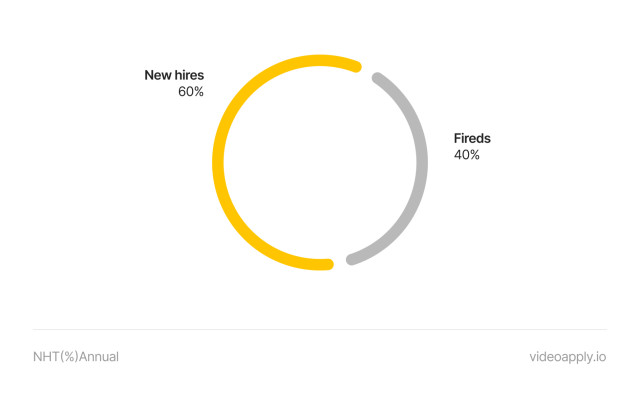
NHT(%)Annual= # of terminated new hires/Total # of terminated employees * 100
Example:
Let’s say you have let go of 25 employees, 15 of whom were hired this year.
Your calculations will be:
NHT(%)Annual=15/25*100
This year’s NHT would be 60%
New Hire Turnover as a percentage of all newly hired employees
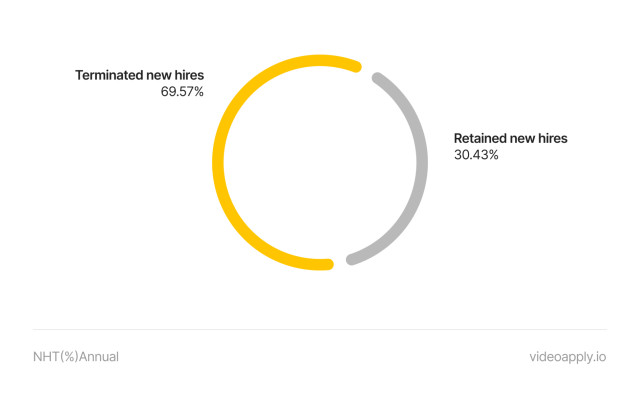
In this case, NHT will indicate a total percentage of terminated employees among new hires.The formula is:
NHT(%)Annual=# of terminated new hires/ Total # of new hires * 100
Example:
Let’s say you hired 23 employees this year and let go of 7.
Your calculation will be:
NHT(%)Annual=7/23*100
NHT for this year would be: 30.43%
For both methods, you can select any time period you want, but be sure it stays consistent between different calculations in order to compare the results correctly. You can also separate the metric into managed and unmanaged attrition.
Managed attrition means that an employee was let go by the employer. Unmanaged turnover means that an employee left by their own volition.
What are the benefits of measuring it?
Avoiding Liability
An employee who leaves before reaching their full productivity level is a serious loss for any business, losing all the money paid for hiring expenses, onboarding, and signing bonuses. By tracking New Hire Turnover you can identify the attrition problem early and cut potential losses accordingly.
Insight into your company’s management
More than 70% of employees who quit their jobs do so due to bad management and a toxic work environment. Too many managers don’t onboard new employees properly and act unprofessionally, which leads to new hires leaving before integrating into the company. Calculating NHT and finding it too low can enable you to seek reasons for turnover inside your company and identify the problems that lead to early attrition.
Final Word
Recruitment KPIs we listed in this article were carefully selected to boost the hiring efficiency of businesses that do not employ the services of professional recruiters and HRs. These metrics are easy to track and calculate and will assist you in developing a suitable recruitment strategy, planning for issues before they arise, and optimizing your recruitment spending.


